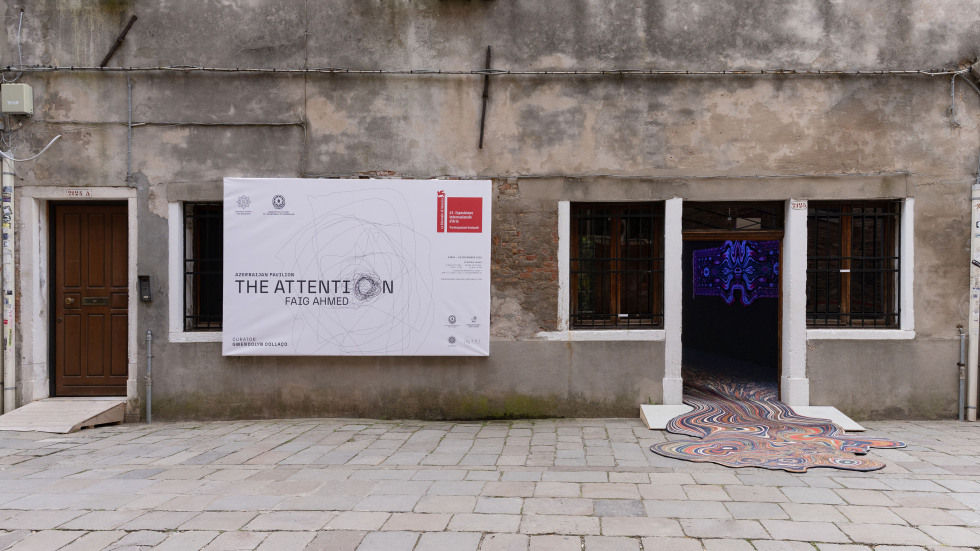
cover magazine: The Attention–the Faig Ahmed experience at the Venice Biennale 2026
- Jul 9
- 3 min read

Azerbaijan’s contribution to this year’s Venice Biennale is a stunning installation by Faig Ahmed. COVER Editor Lucy Upward takes a look at the installation and speaks to the artist.
Stages for the global art scene do not come much more revered than the Venice Art Biennale. Azerbaijan has been appearing on that stage since 2007. A line-up of impressive installations, organised by the Heydar Aliyev Foundation and the Ministry of Culture of the Republic of Azerbaijan, has represented the country’s top artists.
For 2026, the focus is on Faig Ahmed, an artist well-known and respected for his surrealist rug weavings that impart commentary on consciousness. More than a year ago, Ahmed was invited to represent his country at this year’s 61st Biennale; his response then was inevitably ‘a mix of excitement and a strong sense of responsibility’. COVER readers will be familiar with Ahmed’s work, which twists the narrative of traditional Azerbaijani rug design. When I ask him if this work is a summation of where his work is today, he replies that it represents more of an ongoing process.
‘An artistic practice never really has a final conclusion,’ he says. ‘There are only visible fragments of it. Sometimes those fragments reflect a particular state in time. In my case, I think this exhibition represents a state of transition.’ In his installation, The Attention, visitors are taken on a journey looking at cultural symbolism and shared consciousness through the marriage of ancient craft and technology. Housed at Campo della Tana, the exhibition is curated by Gwendolyn Collaço, Anne S.K. Brown Curator for Military and Society at Brown University. In her accompanying essay, she discusses Ahmed’s work in relation to the poetry of medieval mystic Nasimi and to advances in neuroscience and quantum physics. Collaço writes: ‘By wielding his iconic carpet sculptures as the shared framework and physical path for that cosmic journey, Faig Ahmed distills his works down to color, texture, line, and sound.’
The melting carpet at the entrance of the display—Can Contain Both Worlds But Do Not Fit Into This One (2026)—is named after a famous poem by Nasimi. It leads the viewer through the seven rooms of the pavilion, weaving the narrative and commanding the ‘attention’ for which the installation is named. Ahmed describes how the carpet guides us ‘both literally and metaphorically’. In the pavilion catalogue he says the carpet becomes a knot, a particle, a concentration of knowledge, memory, thought, and identity.’
Follow along, and the carpet metamorphoses into a traditional Azeri rug pattern; the room becomes dark, to signify a change from the real world into the mind. Here visitors are met with Ancestors (2026), a glowing rug in which the central section is reduced to abstracted colour and shape.
Continuing on the pathway through The Attention, the carpet transforms again into what is titled Face It, a gigantic folded mountain of weaving that blocks the path. This ‘pile of pile’ is overwhelming and disruptive. ‘For thousands of years, these patterns have symbolised stability and comfort to us,’ Ahmed tells me. ‘Because of that, we instinctively trust them. But sometimes something so familiar can radically transform and lose its identity.’
The viewer is transported not just visually but by the chanted verses of Nasimi in numerous languages. Find the right spot and the multiple voices become one clear message.
The final work is Entropy Altar (2026), a quantum random number generator that produces ‘collective poetic threads’ from data relating to pavilion visitors. As Collaço writes: The viewers’ attention collectively shapes the numbers and letters produced in the installation, which positions consciousness as the cosmological loom to this social fabric.’ For Ahmed, the connections he has made at the show have been rewarding and ‘precisely what I hoped for’. He comments: This experience becomes especially present through Entropy Altar, the interactive installation in the final room of the pavilion that has drawn significant attention from the public. The work invites visitors into a moment of reflection and interaction, where, through art and science, a person ultimately experiences themselves.’


Comments