ocula.com: Azerbaijan’s Venice Pavilion to Honour Late Curator’s Vision
- Mar 2
- 2 min read

The show by textile artist Faig Ahmed and curator Gwendolyn Collaço will continue Koyo Kouoh’s commitment to interdisciplinary dialogue.
By Philippa Kelly – 2 March 2026, Venice
Azerbaijan’s pavilion at this year’s Venice Biennale will pay homage to the creative framework of late curator Koyo Kouoh, who was to serve as the artistic director for the 2026 edition of the biennale, the team behind the national pavilion announced today.
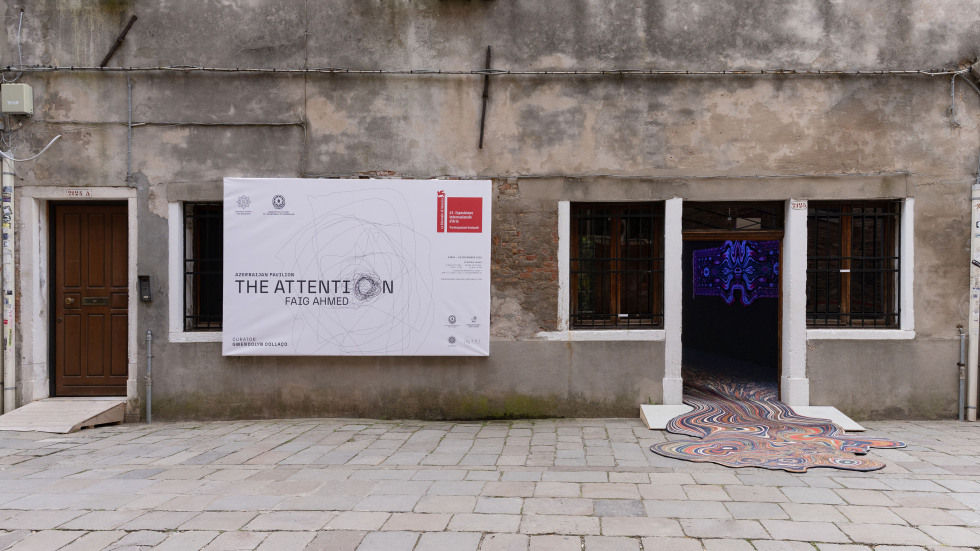
The country will present The Attention, a solo presentation of new commissions by artist Faig Ahmed, known for his large-scale surrealist textile installations. From 9 May the show will transform the historic 16th-century building of Campo de la Tana in the Castello district into an immersive, sensory environment.
In keeping with Kouoh’s vision for the Venice Biennale’s 61st edition, titled Minor Keys, the space will invite meditative perception, reflection and inner recalibration. “The Attention reflects Koyo Kouoh’s curatorial legacy through the exploration of the language of art as a form of individual interaction with the viewer,” Ahmed told Ocula.
“By combining ancient mystical poetry and contemporary hypotheses about the structure of the universe, The Attention creates an environment where a person can interact with themselves, discovering something hidden within their own consciousness…In this way, the project continues Kouoh’s commitment to interdisciplinary dialogue and to the inclusion of local knowledge within the global language of art.”
Central to The Attention is the carpet, a key and recurring element in Ahmed’s artistic practice. The artist’s site-specific commission, I Can Contain Both Worlds but I Do Not Fit Into This One (2026), will span all the rooms of the pavilion, and will spill out onto a nearby street.
Alongside traditional techniques, with Entropy Altar (2026), Ahmed will incorporate advanced technologies. A quantum chip will be used to generate random numbers that transform into a stream of language, creating unpredictable outcomes for visitors and transforming the work into a contemporary mystical altar.

Conceptually, this work takes inspiration from the Hurufi mystic tradition, and specifically from the Azerbaijani poet and thinker Imadaddin Nasimi. Hurufism envisioned a world in which the universe itself acts as a coded structure and attention is a primary path to knowledge, while Nasimi rejected dogma and imposed hierarchies of meaning.
Gwendolyn Collaço, the curator of Azerbaijan’s pavilion, told Ocula: “Ahmed’s fearless venture captures how the power of analogy can illuminate the shared objectives of art and science to unveil the potential of collective consciousness in a world vying for ever precious attention.
“The encoded structure of textile arts takes on new meanings to preface the visual idiom of quantum physics and the underwritten codes of the universe, which infuse humanity as deeply as the poetic verses we consume across time.”
Kouoh, a widely respected curator and the first African woman chosen to lead the Venice Biennale, died suddenly on 10 May last year in Basel, Switzerland. It was confirmed later the same month that the edition would be overseen by her core team, and would be completed in strict accordance with her vision.
Speaking at a recent press conference, Kouoh’s curatorial team said In Minor Keys “proposes a radical connection with art’s natural habitat and role in society”. The Venice Biennale will run from 9 May to 22 November.


Comments