stupiddope.com: Faig Ahmed’s The Attention Weaves Quantum Theory Into Textile Art at Venice Biennale

Faig Ahmed Expands the Language of the Carpet
Faig Ahmed has spent much of the last decade redefining what a carpet can be. Working from the visual traditions of Azerbaijani weaving, the Baku-based artist has become internationally recognized for textile sculptures that appear to melt, distort, and digitally glitch. His work often begins with patterns that seem familiar and historically grounded before unraveling into forms that challenge assumptions about craft, technology, and perception.
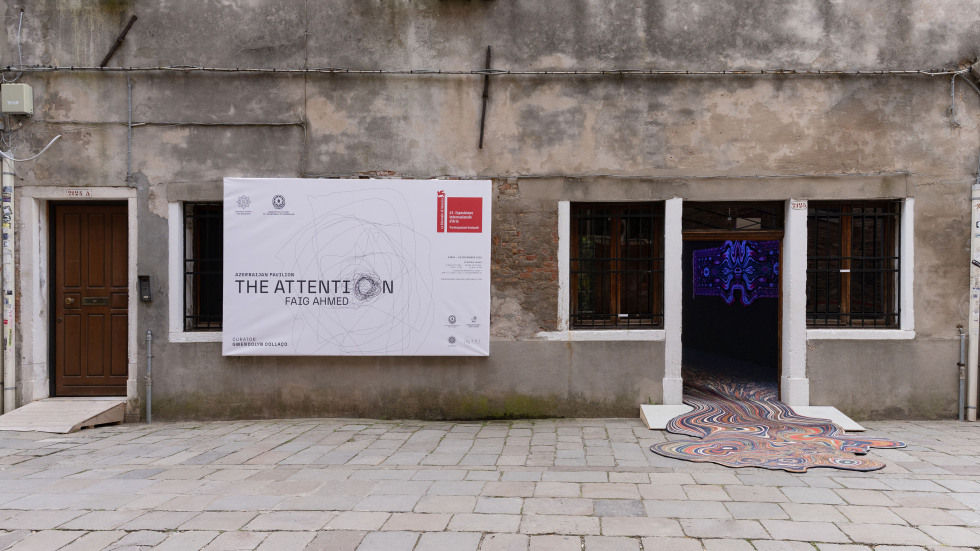
For the 61st Venice Biennale, where Ahmed represents Azerbaijan, the artist pushes that inquiry into more explicitly philosophical territory. His solo exhibition, The Attention, transforms a labyrinthine venue in Venice into an immersive environment where textiles, science, spirituality, and information theory converge. Rather than treating the carpet solely as an object of cultural heritage, Ahmed uses it as a conceptual medium capable of carrying ideas about consciousness, entropy, grief, and human connection.
Curated by Gwendolyn Collaço, The Attention marks an ambitious expansion of Ahmed’s practice. The exhibition retains the tactile intensity and visual surprise that define his best-known works, while opening broader questions about how people construct meaning in an age shaped by both ancient symbols and advanced computation.
The Carpet as a System of Knowledge
In many parts of the world, carpets are often understood as decorative or domestic objects. Ahmed approaches them differently. For him, weaving is a language, and each knot functions as a unit of encoded information. Patterns become systems for storing memory, transmitting belief, and organizing relationships between individuals and their environments.
This perspective aligns naturally with Azerbaijani carpet traditions, which have long carried symbolic and regional significance. Motifs can communicate stories, spiritual concepts, and local identities. Ahmed preserves this historical foundation while introducing contemporary concerns, particularly the ways digital technologies now structure human experience.
The resulting work occupies a productive tension between old and new. Handwoven forms rooted in centuries of craft begin to resemble software errors, unstable data streams, or visual disruptions. These transformations suggest that traditional knowledge systems and modern information networks may be less different than they appear.
Science and Mysticism Share a Common Vocabulary
The conceptual framework of The Attention draws from disciplines not often discussed in the same breath. Ahmed references quantum physics, neuroscience, alchemy, and spirituality, treating them as parallel efforts to understand how reality is constructed and interpreted.
At the center of the exhibition is the idea that the universe may itself operate as a coded system. This notion echoes both cutting-edge scientific inquiry and the 15th-century Hurufi tradition, a mystical school that regarded letters and numbers as fundamental structures through which divine meaning could be revealed.
Hurufism proposed that language was more than communication; it was architecture. Reality could be read, decoded, and understood through symbols. Ahmed adapts this worldview to the present, suggesting that contemporary society has developed its own symbolic infrastructure through algorithms, binary systems, and data flows. The exhibition does not argue that science and mysticism are equivalent. Instead, it reveals how both attempt to map invisible forces and explain humanity’s place within larger systems.
John Wheeler’s “It From Bit” Becomes Material
One of the most influential concepts informing The Attention is physicist John Archibald Wheeler’s theory of “it from bit.” The phrase proposes that physical reality ultimately arises from information. Matter, space, and force may emerge from binary decisions—the most elemental yes-or-no structures imaginable.
Although abstract, the concept finds a remarkably intuitive expression in Ahmed’s practice. Weaving itself is inherently binary. Threads pass over and under. Knots are either tied or not tied. Complex visual and symbolic structures emerge from countless simple choices.
This relationship makes the carpet an unexpectedly apt metaphor for information theory. Each thread contributes to a larger pattern, much as bits combine to create images, languages, and digital environments. Ahmed’s work turns this analogy into physical experience, allowing viewers to move through systems that feel both tactile and conceptual.
The Attention as an Immersive Environment
Installed at Campo della Tana in Venice’s Castello district, The Attention unfolds as a maze-like sequence of rooms connected by textile forms that appear to breathe, spill, and transform. Carpets twist across floors, climb walls, and extend through doorways, creating the sensation of entering a living network.
The continuity of these works is crucial. Rather than presenting individual pieces as isolated objects, Ahmed constructs an environment in which each element contributes to an evolving narrative. Visitors navigate not only through space but through a layered system of references involving physics, memory, grief, and belonging.
The installation’s title suggests both focus and care. To pay attention is to notice patterns, perceive relationships, and remain present. In a culture defined by relentless data streams and fragmented concentration, Ahmed proposes attention as a meaningful and increasingly scarce form of engagement.
Monumental Works Anchor the Exhibition
Among the exhibition’s most significant works is I Can Contain Both Worlds But I Do Not Fit Into This One, a monumental machine-woven textile that Ahmed describes as a breathing body. The piece climbs the architecture, folds inward, and spills across the space with a sense of physical and emotional tension.
The title captures one of the exhibition’s central concerns: the challenge of existing between multiple systems of understanding. Tradition and technology, spirituality and science, subjective feeling and measurable data all coexist, yet their coexistence can feel disorienting.
Another standout work, Ancestors, is handwoven and faintly anthropomorphic. Under black light, it emits a psychedelic glow that lends the piece an almost spectral presence. It evokes lineage not as a fixed inheritance but as an active and luminous force.
Entropy Altar introduces a more explicitly technological dimension. Using a quantum random number generator, the installation translates visitor presence into an evolving symbolic language. The work makes participation itself a material, reinforcing the idea that observation alters systems rather than merely documenting them.
Information Overload and Collective Grief
The Attention resonates particularly strongly in a historical moment defined by excess information. News cycles, social media, and algorithmic feeds expose individuals to unprecedented volumes of data while often reducing opportunities for reflection.
Ahmed addresses this condition through a medium associated with patience and labor. Weaving requires time, repetition, and concentrated attention. Every thread is placed deliberately. In this sense, the carpet becomes a quiet rebuttal to the speed and disposability of digital culture.
The exhibition also engages with collective grief, suggesting that information alone does not produce understanding. Meaning emerges through interpretation, connection, and embodied experience. Ahmed’s textiles offer a framework for processing complexity rather than escaping it.
Faig Ahmed Reimagines Craft as Contemporary Philosophy
The Attention confirms Faig Ahmed’s position as one of the most intellectually compelling artists working with textiles today. By merging Azerbaijani weaving traditions with quantum theory, Hurufi mysticism, and participatory technology, he demonstrates that craft can function as a sophisticated form of philosophical inquiry.
The exhibition expands the role of the carpet from cultural artifact to conceptual instrument. Threads become data, patterns become cosmologies, and weaving becomes a way of thinking through some of the most urgent questions of the present.
On view through November 22 at Campo della Tana, Castello 2124/A–2125 in Venice, The Attention offers visitors a rare opportunity to encounter art that is as materially rich as it is intellectually ambitious. Readers interested in learning more about Faig Ahmed’s evolving practice and Azerbaijan’s presentation at the Venice Biennale can explore the artist’s official channels and exhibition resources.


Comments